
2nd April 2026
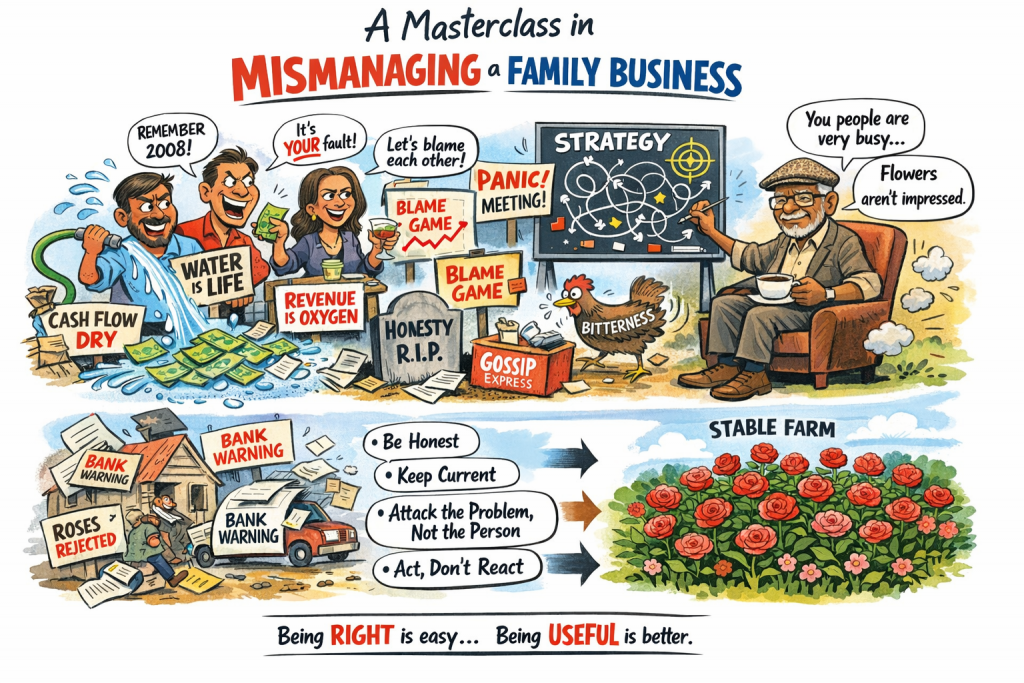
Once upon a time, there existed a flower farm so well run it bordered on suspicious. Roses were graded tighter than family secrets, costs were tracked like contraband, and even arguments had KPIs. Under the old patriarch, things worked. Systems functioned. People behaved. Drama, where it
existed, had the good manners to remain productive.
Then the patriarch exited gracefully, permanently, and without leaving behind a user manual. What followed was less a transition and more a live experiment: what happens when structure leaves the room and emotions take over operations?
The siblings stepped in.
Not gradually. Not strategically. Suddenly and with the unshakable confidence of people who had always had strong opinions and absolutely no consequences. Power was divided with the elegance of a constitutional crisis. One took irrigation, declaring, “Water is life,” which was true agriculturally but less convincing interpersonally, given the emotional drought he introduced. Another took sales, insisting “revenue is oxygen,” though oxygen, like the cash flow soon became largely theoretical. The third took “strategy,” a role defined by diagrams, big words, and an advanced resistance to making actual decisions.
Together, they inherited the Four Rules of Communication. Together, they dismantled them with the efficiency of a pest outbreak.
Rule 1: Be honest
Honesty evolved into performance art. “Let me be honest…” became less a promise and more a warning that reality was about to be gently rearranged. Production figures were “encouraging” (if you avoided looking at them). Expenses were “temporary” (like Naivasha rain; brief, inconvenient, and somehow very expensive). Losses were “investments in resilience,” which sounded strategic because it was unaffordable.
Everyone spoke confidently. No one verified anything. Truth, sensing a hostile work environment, quietly resigned. Gossip, meanwhile, achieved same-day delivery something logistics had been chasing for years.
Rule 2: Keep current
This rule died early and without ceremony. Meetings became archaeological digs. “Before we discuss labour costs,” one sibling would begin, “we must revisit what happened in 2020 when you failed to clap after my presentation…”
And just like that, wages turned into a historical re-enactment. Grudges were not only preserved they were curated, updated, and occasionally upgraded. Each sibling maintained a mental archive of past offenses with better record-keeping than the farm’s financials. If bitterness could be exported, the farm would have diversified successfully.
Rule 3: Attack the problem, not the person
This rule was not misunderstood. It was deliberately inverted. Problems became abstract concepts. People became very specific targets.
“You are inefficient.”
“You are the inefficiency.”
“You are the reason efficiency left this farm.”
Crop disease? Someone’s fault. High wage bill? Someone else’s fault. Rejected flowers? A group effort in blame distribution.
Even pests weren’t safe from metaphor. At one point, a discussion about thrips ended with someone being compared to one unfavourably. The farm manager, once focused on yields, now maintained two key datasets: production metrics and insult archives.
Rule 4: Act, don’t react
By now, reacting had become the farm’s core competency.
Prices drop? Panic meeting.
Prices rise? Suspicious panic meeting.
Supplier delays? Outrage.
Supplier delivers? Distrust.
Everything triggered urgency. Nothing triggered clarity. Planning was treated like optional reading. Drama was compulsory. A decision about greenhouse plastic lasted longer than the plastic itself would have. The farm became a case study in movement without direction a proof that activity and progress are not on speaking terms.
Externally, people began to… notice.
Buyers adopted careful language. Suppliers developed commitment issues. Workers mastered silent observation, then quietly left. Bankers acquired that polite tone that translates to, “We are watching you.” Regulators and communities started circling, using words like “sustainability” in ways that felt less like advice and more like investigation.
Enter Mzee Kamau.
An old friend of the patriarch. Described by the siblings as “old school,” “traditional,” and most damningly, “not really understanding modern business” a conclusion reached while modern business was actively collapsing around them. They ignored him for months. An impressive feat, considering he was one of the few things making sense.
Eventually, reality intervened. Bank messages developed deadlines. Export rejections came with destruction bills. Employees slowed down. Suppliers demanded cash or disappeared entirely
Mzee was invited in not to advise, of course, but to witness what they believed was a sophisticated leadership process. He sat quietly as the siblings argued with remarkable stamina and zero outcomes. When they paused, more from exhaustion than agreement he spoke.
“You people are very busy,” he said. “But nothing is moving.” Silence. Then, calmly, he repeated the four rules they had inherited and creatively destroyed:
“If you know the truth, say it. Not decorated versions.”
“If yesterday had problems, finish them there. Today has work.”
“Stop fighting each other. Even weeds have better teamwork.”
“And please, reduce the noise. Flowers are not impressed.”
No slides. No frameworks. No “Reimagining Synergistic Alignment in Family Agribusiness Systems.” Just clarity.
Something shifted. Maybe it was financial pressure. Maybe it was collective fatigue. Or maybe it was the uncomfortable realization that the least “modern” person in the room was the only one who understood how things actually worked.
Change came slowly. Meetings shortened; partly from discipline, partly from exhaustion. Voices lowered. Numbers, once imaginative returned to reality. Problems were discussed without character assassination. History stopped attending meetings uninvited. Decisions were made, implemented, and occasionally left alone.
And the roses, having endured months of emotional instability, quietly resumed their work; growing, minding their business, and forming absolutely no committees. By season’s end, the farm stabilized. Not perfectly. Not magically. But enough to prove a point. A business works best when it is treated like one not like a competitive sport in unresolved emotions.
The siblings, now slightly wiser and significantly less theatrical, developed a new respect for Mzee Kamau not for his education or vocabulary, but for his rare ability to say simple things and mean them.
Because in the end, after all the meetings, arguments, and near-financial disasters, they learned what should have been obvious from the start: A family business does not collapse because of markets. It collapses because people confuse being right with being useful.
A lesson they would later acknowledge quietly, and for once, without forming a task force.