
I used to believe logistics failures happened at the airport. Congestion, delays, paperwork surely that’s where things fall apart. It was a comforting belief. It also turned out to be expensive.
My turning point began, as many disasters do, with confidence. Harvest looked good. The team was moving fast. Boxes were packed, labeled, and dispatched with what I proudly called “efficiency.” Planning, in my view, was something you did broadly. Execution? That was for the day things moved.
What I did not fully appreciate was that, in floriculture, time does not start at the airport, it starts at harvest. And if you get that wrong, everything else is just a well documented failure.
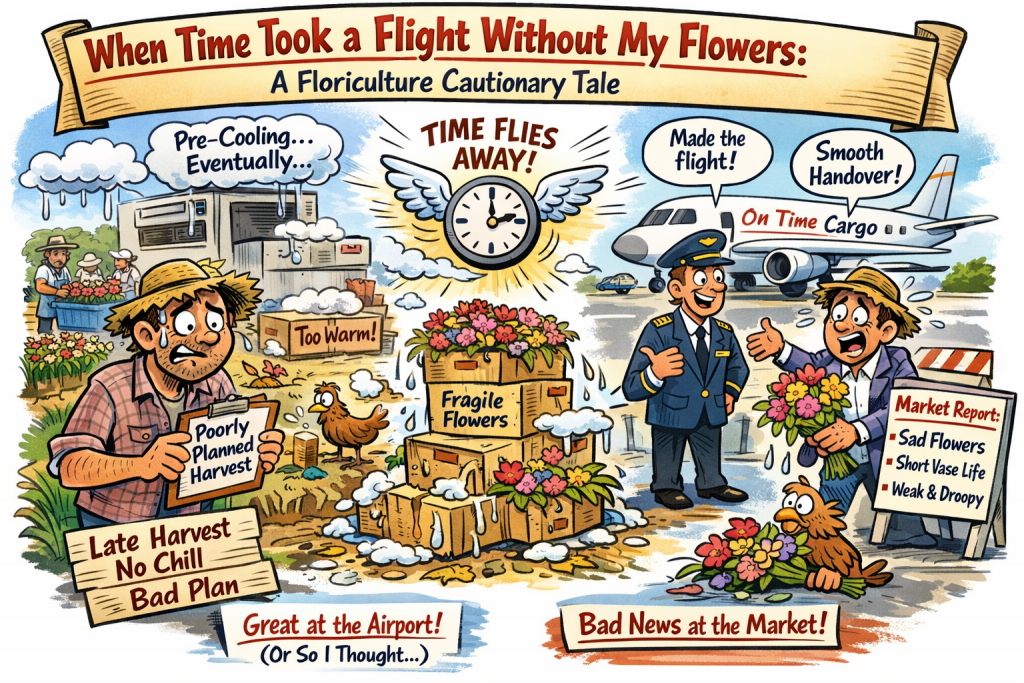
We harvested a little later than ideal. Nothing dramatic just waiting for “perfect” bloom stage. Pre-cooling? It happened… eventually. The cold room was full, but we made a plan (a dangerous phrase, in hindsight). Boxes waited. Flowers respired. Time, as I later learned, quietly slipped away long before logistics officially began.
By the time the consignment reached the airport, it looked like a success story. Smooth handover. On schedule. Minimal fuss. I remember thinking, this is how it’s done.
Then came the feedback from market.
“Reduced vase life.”
“Inconsistent quality.”
“Temperature stress indicators.”
In short: the flowers had arrived… but not as themselves.
That’s when the uncomfortable truth landed faster than my shipment ever did. Nothing had gone “wrong” at the airport. The system had worked exactly as designed. The problem was that I had designed it poorly and executed it even more loosely.
I had treated planning as optional detail and execution as reactive effort. In reality, the two are inseparable. Planning sets the biological limits. Execution determines whether you stay within them.
What I had missed spectacularly was the primacy of early decisions. Harvest timing, field heat removal, cold-chain discipline: these are not small operational steps. They are where logistics performance is decided. By the time flowers are in transit, you are no longer managing quality you are negotiating with what remains of it.
In my case, there wasn’t much left to negotiate.
The real irony? I spent days questioning freight delays that never mattered, while ignoring hours at harvest and pre-cooling that cost me everything. Time was not lost in transit. It was spent carelessly at the start.
These days, I plan differently. Not perfectly, but deliberately. And execution is no longer about “getting things moving,” but about protecting what was planned.
Because in this business, time doesn’t disappear. It keeps score.