
16: 04: 2026
By Akshay Desai
What would climate change mean for my supply chains?
In the previous articles, we discussed about the Physical and Transition Climate risks that would affect the businesses, in terms of both the opportunities, and the risks.
This time we look at a simple framework of stress testing, similar to what financial firms do, to manage Risks, and Opportunities through Stress testing of Supply Chains for Resilience.
Step 1: Forecasting the Climate Chage – Disruptions and Opportunities
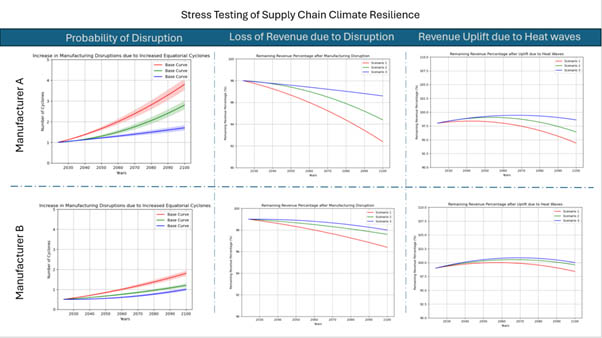
In the example above, we see several derived scenarios for Manufacturer A – Who has factories located on the seacoast, and Manufacturer B, whose factories are located inland.
One could use the Representative Concentration Pathways (RCP), which indicate probable scenarios of climate change, to forecast the Number of expected cyclonic storms at either of the Manufacturers factories.
It seems that Manufacturer A, has more factories located along the region where the Physical risk of climate change – the number of cyclones per year – is going to be considerably large as compared to the Manufacturer B.
Step 2: Quantifying the Disruption and Opportunities
Quantifying Disruptions – Now, one could from historical data or consensus estimate that for every cyclone that a factory faces, there is a potential shut down of 7 days. This then translates to 7 days risk interval. This thus translates to a revenue at risk equivalent to 7 days’ worth of corresponding sales. (In simplistic terms)
Expected value at risk of Disruption = Probability of a cyclone happening in a year * Impact of cyclones.
Quantifying Opportunities – Similarly, in the third graph, we also see that increased heat waves, are forecasted to uplift the revenues by a certain percentage point over the next decades.
Expected Lift in Revenue = Probability of heat waves * Impact on sales
Step 3: Managing the Risks and Opportunities
Once the impact of disruptions and opportunities is gauged through the stress test, the manufacturers could decide to either.
A) Transferring the Risk to insurance companies.
B) Avoiding the Risk by moving the factories out of the cyclone prone areas
C) Mitigating the Risks by either building inventory of components supplied by the factories or by diversifying the factory locations
D) Accepting the Risks by taking a cognizant deliberate decision to accept the losses, when they come.
Companies will, also adopt to capitalize on the Opportunities such as increased sales due to heat waves by forecasting for the heat waves and building inventories for the same.
Stress testing of business operations can help build resilient and successful business strategies for the future.