
07: 05: 2026
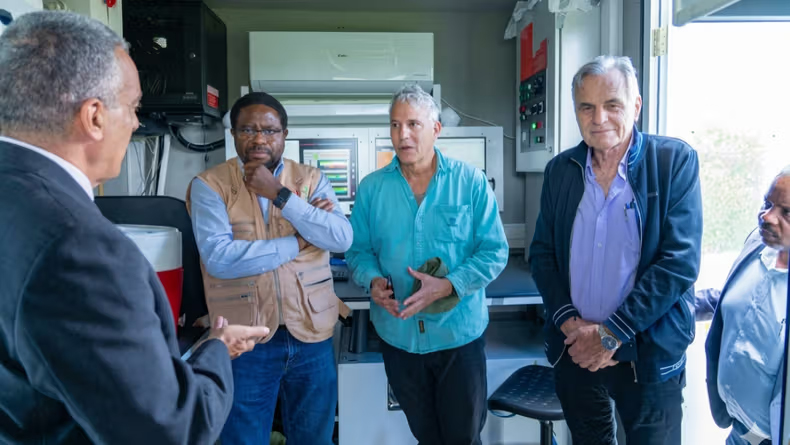
Kenya is hosting what is believed to be the world’s first mobile climate laboratory, a pioneering initiative led by Israel that could significantly strengthen Africa’s climate research capacity and improve the precision of environmental decision-making across the continent.
The state-of-the-art facility, currently stationed at the International Livestock Research Institute (ILRI) research station in Kapiti, Machakos County, is being operated by Israel’s Weizmann Institute of Science. After two months of operation in Kenya, scientists say the laboratory is already generating critical ground-based data needed to address one of Africa’s biggest climate science challenges: a chronic shortage of reliable, on-the-ground environmental measurements.
The deployment marks an important step in filling what experts describe as Africa’s “climate data blind spot” — a major limitation that has long undermined accurate climate modelling, forecasting, and policy planning.
Speaking during a recent visit to the site, Israel’s Ambassador to Kenya, Gideon Behar, said the project is intended to help bridge the continent’s longstanding data deficit.
“There is a huge gap in climate data and climate knowledge in Africa, and the work of this laboratory helps us close this gap,” Behar said. “It will enable governments, scientists, and institutions to make better policy decisions based on real and accurate science.”
The mobile unit is equipped with more than 30 advanced scientific instruments capable of measuring key environmental variables, including carbon exchange, solar radiation, water use efficiency, soil-atmosphere interactions, and vegetation dynamics.
Such measurements are particularly valuable because much of Africa’s climate monitoring currently relies heavily on satellite observations, which often lack sufficient field validation.
Researchers say the laboratory’s mobility sets it apart from conventional fixed research stations. Its ability to move across ecosystems — from arid rangelands to highland forests and agricultural landscapes — will allow scientists to gather comparative data across diverse climatic zones.
According to Eyal Rotenberg, one of the project’s lead scientists, this mobility is essential for improving climate model calibration.
“Models are not well calibrated because there has been very little measurement,” Rotenberg said. “This initiative will provide the field data needed to validate and significantly improve those models.”
The project arrives at a critical time for Africa, a continent widely regarded as one of the most vulnerable to climate change despite contributing minimally to global greenhouse gas emissions.
For Kenya’s agriculture sector — including floriculture, which depends heavily on predictable weather patterns, water availability, and temperature stability — more accurate climate data could prove invaluable.
Better climate modelling could support more informed decisions on irrigation scheduling, greenhouse energy management, pest and disease forecasting, and long-term production planning.
Appolinaire Djikeng, Director General of ILRI, said the facility will strengthen evidence-based responses to mounting environmental pressures.
“We are in a society where data drives decisions. The pressure created by the climate crisis demands precision, and this facility enables us to generate the evidence needed to guide sustainable food production and environmental management,” he said.
The Kapiti research station has long supported livestock and rangeland studies, but the addition of the mobile climate laboratory broadens its scope significantly, enabling deeper research into climate variability, biodiversity resilience, and ecosystem productivity.
The initiative is expected to remain in Kenya for at least three years, with future deployments planned for Mount Kenya and later expansion into Tanzania and South Africa.
Scientists hope the project will lay the groundwork for a broader continental climate monitoring network.
For Africa’s agricultural industries, including floriculture, the message is clear: better data means better decisions — and in an era of increasing climate uncertainty, that knowledge may prove as valuable as any physical infrastructure.