
21: 05: 2026
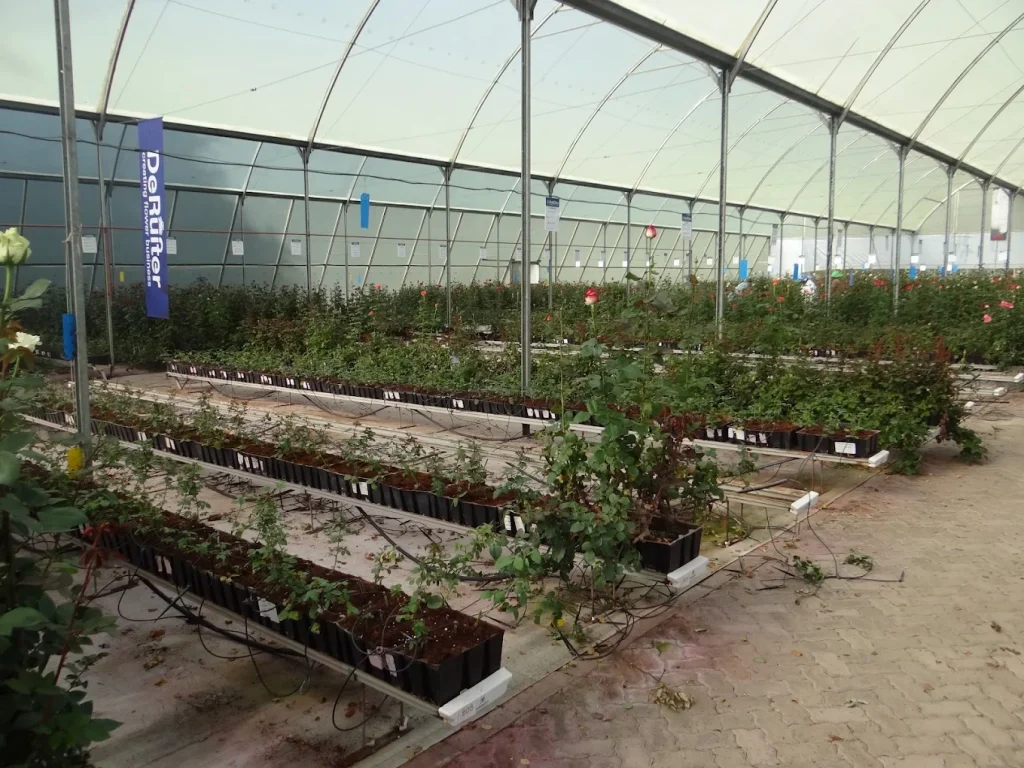
Deciphering the jargon behind your growing media’s physical properties is not just academic. For Kenyan flower growers, it directly translates into healthier crops, stronger stems, and blooms that last longer on the retail shelf in Europe, the Middle East, and beyond.
Ask a room full of growers how they want to improve their substrate (growing media), and you will hear a dozen different answers. One of the most common is: “I want better drainage.”
The problem? “Drainage” is vague. In modern, soilless production systems, it is an umbrella term that hides many different physical and irrigation-related factors. Unless we define these clearly, growers, consultants, and substrate suppliers can easily talk past each other – and miss opportunities to improve crop performance.
This article unpacks what “drainage” really means in container and greenhouse systems used across Kenya’s flower sector, so that you can better diagnose challenges, adjust your mixes, and fine-tune your irrigation.
What Drainage Really Means in Soilless Systems
In classical soil science, drainage is defined as the rate and extent of water movement through and across the soil profile. But this definition breaks down when we move to soilless substrates in containers.
On most Kenyan flower farms, crops are grown in containers or beds with a fixed volume and height. These systems do not behave like an open soil profile with endless width and depth.
For substrates, we can think of drainage more practically as:
How fast – and how much – water comes out of the bottom of a specific container when you irrigate it.
This depends on:
• The type and blend of substrate
• The container’s shape and height
• How the substrate is filled and compacted
• How water enters the surface (infiltration)
• How water is stored (water-holding capacity)
• How water moves through the profile (hydraulic conductivity)
All these factors together determine how air space and gas exchange change over time in the root zone – while still ensuring the media holds enough water and nutrients between irrigations to avoid stress.
The Three Key Processes Behind “Drainage”
To move beyond jargon, it helps to break drainage down into three core processes:
1. Infiltration – how water gets into the substrate surface
2. Water-holding capacity – how water is stored in the pore spaces
3. Hydraulic conductivity – how water moves through the substrate profile
The answer for each process will differ depending on:
• The substrate blend (e.g., cocopeat, peat, pumice, perlite, bark, wood fibre)
• Container or slab height and shape
• Irrigation strategy (frequency, shot size, start/stop times)
Over time, root growth and ageing of the substrate components also change these properties – so “drainage” today will not be identical to drainage three or six months into the crop.
Pore Size: Where Air and Water Compete
Pores in the substrate occur primarily between particles. When components are mixed and containers are filled, particles interlock and create a network of pores of different sizes.
• In a fine substrate, like peat or fine cocopeat, you get many small pores that hold water tightly.
• In a coarser substrate, or when you add materials like perlite or pumice, you introduce larger pores that drain more easily and hold more air.
However, the effect of any one component depends on the overall blend:
• Adding perlite to a fine, water-retentive mix can increase air space by creating larger pores.
• The same perlite added to a coarse, bark-based mix can actually reduce air space by filling up existing large pores.
Compaction adds another layer of complexity. If the substrate is packed too tightly during filling or planting, pores become smaller and more irregular, usually resulting in:
• Higher water retention
• Lower air space
For Kenyan growers working with cocopeat slabs, pots, or pumice blends, understanding how filling, pressing, and rehydrating affect pore size is critical to achieving a healthy air–water balance for roses, summer flowers, and fillers.
The Tug of War: Water vs Gravity
The substrate’s total pore space (often 70–90% of the total volume) can be filled with either air or water. Which it holds at any moment depends on the interaction of two main forces:
1. Matric potential Water is held in small pores by capillary forces and on particle surfaces by attraction. This keeps water in place against gravity.
2. Gravitational potential Gravity pulls water downwards. Any pores that cannot hold water against gravity will drain and remain filled with air.
This is the essence of “drainage”: a constant balancing act where water is removed by:
• Transpiration (plants pulling water through the roots)
• Evaporation from the substrate surface and container walls
…and then added back via irrigation, which refills pores with water and changes the air–water balance again.
The portion of the substrate that still holds water after being well irrigated and allowed to drain freely is called container capacity – often used interchangeably with water-holding capacity.
Growers influence the volumetric water content (how much water per unit volume) and air content during production by managing:
• Pore size distribution (through substrate choice and blends)
• Container or slab height
• Irrigation intervals and shot sizes
Infiltration: How Water Enters the Media
Infiltration is simply the speed at which water enters the surface of the substrate.
It is strongly affected by:
• Fineness of the substrate
• Wettability – whether the substrate is hydrophilic (water-loving) or hydrophobic (water-repellent)
A fine or hydrophobic mix, which can easily occur in aged or dried-out cocopeat, often causes water to pool on the surface, leading to uneven wetting. A coarser or more hydrophilic mix allows water to enter more readily and wet more uniformly.
Wetting agents can improve infiltration, especially when re-wetting dry or repellent substrates, but they are not a substitute for correct mix design and irrigation management.
Hydraulic Conductivity: How Water Moves Inside the Pot
Where infiltration deals with water entering the top, hydraulic conductivity is about how water moves through the substrate profile.
This movement can be described under:
• Saturated conditions – every pore is filled with water (immediately after a heavy irrigation)
• Unsaturated conditions – the system ranges from moderately moist to quite dry (almost all real-life greenhouse situations)
For practical purposes in floriculture substrates, we mainly care about unsaturated hydraulic conductivity.
• Fine particles and fibrous components (e.g., coir, peat, wood fibre) can increase unsaturated hydraulic conductivity by providing many small, well-connected pores.
• Coarse substrates with a wide range of pore sizes are prone to preferential flow – water “channels” rapidly through certain pathways, wetting only part of the profile while other zones remain dry.
This preferential flow is most severe in dry substrates and lessens as overall water content increases. Kenyan growers who see some parts of the slab or pot staying dry after irrigation are often experiencing this phenomenon.
Container Height: Why Pot Depth Matters
Container or bed height directly influences gravitational potential.
• Short containers retain more water
• Tall containers drain more and hold more air
If you place containers of different heights side by side, all filled with the same substrate and irrigated similarly, you will find:
• At a given distance from the bottom, the volumetric water content is similar across containers
• The very bottom layer in each container is saturated
This has big implications for plug trays, propagation blocks, coco slabs, and final pots or beds in Kenyan greenhouses:
• Shallow young plant trays hold more water and need careful irrigation to avoid waterlogging seedlings or cuttings.
• Open-cell liners wrapped in paper or mesh encourage more uniform drying and better air exchange, improving root development.
• Closed-cell systems with fewer drainage holes often require deliberate moisture swings – allowing the media to dry more between irrigations to maintain adequate air space.
The Evolving Mix: Substrates Are Not Static
Substrates are dynamic. Each component starts out with relatively well-defined physical properties – maximum water-holding capacity, minimum air space, and so on.
But the moment growers start blending components, filling containers, and running irrigation cycles, the system begins to change.
Over time:
• Roots grow and physically alter pore sizes
• Fibrous or organic components break down and can fill pores or leach out
• Agrochemicals and water quality influence wettability and structure
As a result, the hydraulic properties you measure at the start of a crop will not be the same halfway through. Many Kenyan growers manage this by choosing an initially well-drained, airy mix that is forgiving as it ages.
This strategy gives “breathing room” as the mix evolves – but it can also:
• Waste water and nutrients early on
• Create unnecessary variability in the first weeks of production
That is why growers often use different mixes for:
• Young plants and propagation
• Liners or intermediate stages
• Finished stock or production beds
Each stage requires its own air–water balance, container height, and irrigation strategy.
What This Means for Kenyan Flower Growers
Balancing air and water in containers is central to high-performing floriculture, especially in Kenya where:
• Water costs and availability are under pressure
• Export markets demand consistent quality and long vase life
• Input prices are rising, and waste must be minimized
To move beyond the vague term “drainage,” focus on these factors whenever you design or refine a substrate mix or irrigation regime:
• Density at filling – avoid over-compaction that squeezes out air
• Pore structure and component choice – think about how each ingredient changes pore size distribution
• Infiltration behaviour – watch for surface pooling or uneven wetting
• Irrigation schedule – fine-tune frequency and shot size to manage moisture swings
• Container height and system design – match your mix to your trays, pots, or slabs
• Substrate evolution over time – remember that your “drainage” today is not the same as it will be in six months
By paying attention to these details, Kenyan flower producers can turn the vague wish for “better drainage” into a precise, manageable set of decisions – leading to stronger root systems, more uniform crops, and blooms that meet demanding export standards.
In the end, getting a grip on drip is really about understanding what happens in your growing media after every irrigation event – and using that knowledge to give your plants exactly what they need, when they need it.