
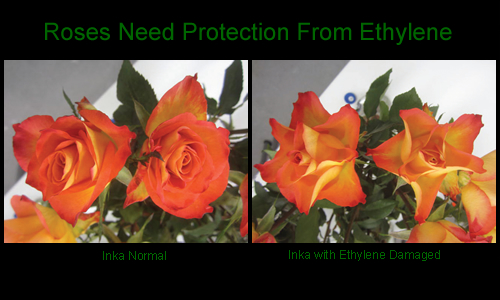
 Several rose varieties sold by European retailers suffer significant and unnecessary quality loss as a result of exposure to ethylene, a recent Dutch study has shown. With a few preventive measures, the post-harvest performance of these roses can be greatly improved. An alternative is to develop ethylene-resistant varieties. Either way, retailers will be able to offer consumers flowers with improved colour and opening and a vase life up to five days longer than today’s average.
The study of the effects of ethylene on roses was carried out in December 2012 and January 2013 by FlowerWatch, a leading Dutch centre for supply chain expertise, monitoring and development, and commissioned by Chrysal Netherlands, a specialist in flower care solutions. In the study, FlowerWatch followed a range of 25 rose cultivars exported to European retail destinations by two Kenyan growers. The researchers monitored the ethylene concentrations to which the flowers were exposed throughout their post-harvest journey from grower to consumer. They looked at the flowers’ sensitivity to ethylene as well as to ethylene inhibitor AVB, a post-harvest conditioner developed by Chrysal.
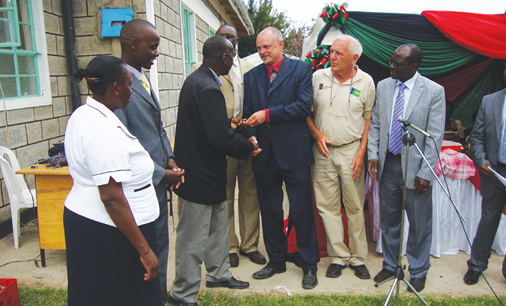 It was pomp and dance at a Nyamathi dispensary as villagers welcomed the handing over of the dispensary maternity wing. The handing over came with an almost audio-recorded oratory of the Naivasha Horticultural Fair Chairman Mr. Roddy Benjamin not frequently heard in this village. Co-ordinating well with seasoned Mr. Richard MCconel the vice Chairman, they touched the hearts of villagers who came in hundreds to grace the occasion.
 “Molo River Farm Ltd are making magic. In other word, they exist for the sake of simplicity. They channel their efforts into taking all the worries over farming and exporting of flowers from their customers, leaving them to concentrate on their core activities in other areas. Their contributions to the flower export business are brief, crisp, penetrating, perceptible, and above all creative insight into the minds of the consumers. Memorable ideas, images and stories, where there is more understanding triumph over information”, I concluded as Mr. Andrew Wambua took me round the farm. In his narration from one department to the other, one statement kept on recurring: No compromising of quality whatsoever.
 Q. Briefly discuss Margaret Njambi (Personal background and professional background to your current position as Technical Manager East Africa, Lawn and Garden at Syngenta East Africa Ltd.)