
07: 05: 2026
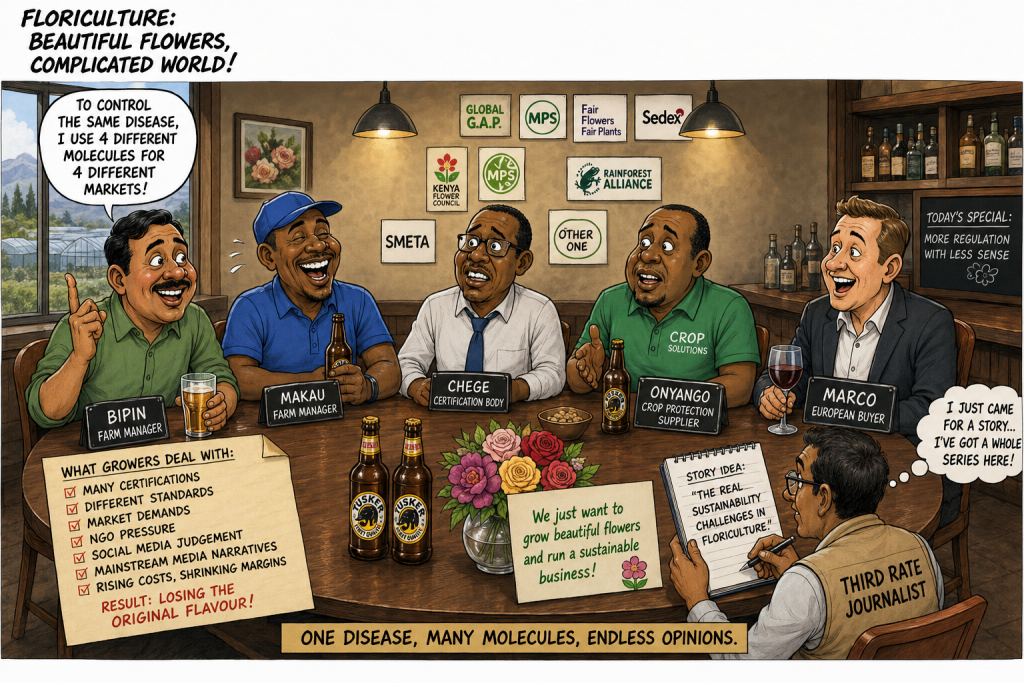
It started, as most misunderstandings in floriculture do, with good intentions and a notebook.
I had spent the afternoon on a flower farm near Naivasha, stepping carefully between greenhouse rows, asking questions that sounded better in my head than they did out loud. Something about sustainability, traceability, and whether workers felt “aligned with environmental goals.” The farm manager had nodded politely in that way people do when they are deciding whether you are serious or just passing through.
By evening, I decided to file my thoughts over a quiet drink.
The bar was not quiet.
In one corner sat Bipin and Makau, two farm managers who looked like they had aged collectively five years since lunch. Between them sat Chege from one of the certification bodies, carrying the expression of a man who had just been blamed—fairly or unfairly—for at least seven compliance failures he did not personally authorise.
I had barely taken a seat when Bipin spotted me.
“There he is,” he announced, pointing like I was late to my own trial. “The man writing about us.”
Makau turned slowly. “Perfect timing. He can explain why I need four different chemical programmes to control one fungus depending on which passport the flower is travelling with.”
Chege sighed. “It is not as simple as—”
“It never is,” Makau interrupted. “That’s the problem.”
They laughed, but it was the kind of laughter that had been reheated too many times.
Then Onyango arrived, shaking off the mood of someone who had spent the day defending crop protection products against accusations that they personally ruin ecosystems, relationships, and possibly childhood memories.
Behind him came Marco, representing a major European buyer, the kind who speaks in phrases like “consumer perception risk” and “ethical alignment frameworks,” as though flowers now require moral clearance before they bloom.
Before I could shrink into my seat, they had all converged on me.
“The journalist,” Bipin said again, this time with theatrical disappointment. “Tell us, what have we done now?”
I tried to smile. “I was just writing about sustainability challenges in the sector.”
“Ah,” Makau said. “So we are already at the ‘challenges’ stage. Good progress. Yesterday we were still at ‘villains of the planet.’”
Marco pulled up a chair. “Let me guess. You saw a certification logo today and assumed harmony exists.”
Chege rubbed his temples. “We don’t even have harmony between certifications.”
That one landed too accurately.
Onyango leaned forward. “Do you know what happens in my week? I explain science to activists who believe molecules have morals.”
Bipin added, “And I explain markets to certification bodies who can’t agree on a single standard but still issue twelve of them.”
Makau nodded. “And I explain to growers why the same disease suddenly has different treatment protocols depending on geography, retailer, and someone’s opinion on LinkedIn.”
All eyes turned to me again.
I felt the familiar discomfort of being both observer and implicated.
“So what’s the solution?” I asked.
Silence settled—not dramatic, just tired.
Finally, Bipin spoke.
“The solution is not more noise. It is alignment. Because right now, everyone is speaking about the industry, but no one is speaking for it.”
Chege looked down. “Even those of us inside certification are fragmented.”
Marco sighed. “Even buyers are inconsistent.”
Onyango gave a short laugh. “Even science is getting edited by opinion.”
No one disagreed.
The bartender set down another round without being asked. That, at least, was still efficient.
Makau lifted his glass. “To flowers that are still trying to be flowers.”
They all clinked.
I stayed a moment longer than I planned, notebook untouched.
Because somewhere between the arguments, jokes, and frustration, I realised something simple: The industry was not lacking expertise. It was drowning in interpretations of it.
And in that bar, for a brief moment, everyone agreed on one thing—the story of floriculture had become far more complicated than the flowers themselves.