
09: 04: 2026
For over six decades, Colombia has been one of the defining forces in global floriculture, building a $2.4 billion export industry that today supplies roughly 60 percent of all flowers
sold in the United States . What began in 1965 as a modest shipment of cut flowers from Bogotá to Miami has evolved into one of the most sophisticated, vertically integrated, and market-driven flower industries in the world.
Yet, as 2026 unfolds, this success story is entering a more complex phase—one shaped by shifting trade dynamics, rising production costs, and a rapidly evolving global marketplace. For international buyers, traders, and growers, Colombia’s trajectory offers both a benchmark and a warning.
A Market Built on Scale and Precision
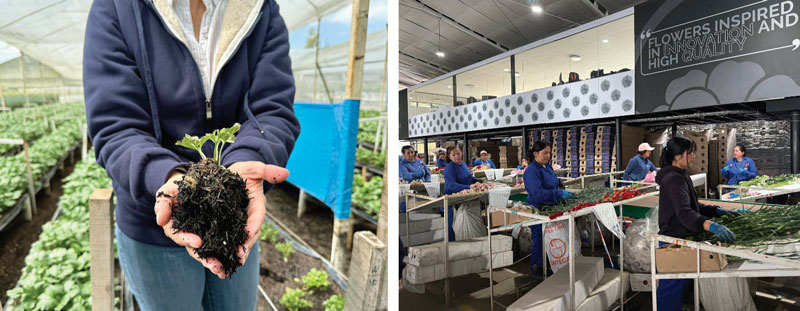
Colombia’s floriculture sector is not just large—it is deeply embedded in both local livelihoods and global supply chains. The industry employs over 200,000 people across more than 115 municipalities, with women forming the backbone of the workforce . With more than 10,000 hectares under cultivation—making it the largest exporter by area globally—production is concentrated around Bogotá and Medellín, where high-altitude conditions provide ideal growing environments .
Product diversity has also become a hallmark of Colombia’s competitiveness. While roses, carnations, and chrysanthemums remain dominant, the country now produces over 1,600 varieties, with hydrangeas emerging as one of the fastest-growing segments . This breadth allows exporters to respond quickly to shifting consumer preferences, particularly in high-value retail segments.
Between 2019 and 2024, export values grew at an impressive compound annual rate of 9.8 percent, underlining strong global demand and Colombia’s ability to scale efficiently .
The U.S. Market: Opportunity and Vulnerability
No discussion of Colombian floriculture is complete without the United States. In 2025, the U.S. accounted for approximately 80 percent of Colombia’s flower exports by value . The relationship is deeply symbiotic: nearly 80 percent of flowers sold in the U.S. are imported, and Colombian stems dominate supermarket shelves and bouquet assortments.
This dominance has been underpinned by logistics excellence. Bogotá’s El Dorado Airport and Miami International Airport form one of the world’s most efficient perishables corridors, with up to 35 cargo flights per day during peak seasons like Valentine’s Day . From there, an extensive distribution network ensures flowers reach thousands of retail points across North America within days.
However, this heavy reliance on a single market now presents a strategic risk.
Tariffs, Costs, and the Margin Squeeze
The reintroduction of a 10 percent U.S. tariff on Colombian flowers in 2025 marks a significant turning point. For an industry that enjoyed duty-free access for over a decade under the U.S.-Colombia Trade Promotion Agreement, the shift is profound. The tariff alone is estimated to add more than $200 million annually in costs .
At the same time, growers are grappling with a 23.7 percent increase in minimum wages and a nearly 12 percent appreciation of the Colombian peso . With labor accounting for up to 60 percent of production costs, the impact is immediate and widespread.
The result is a classic margin squeeze: rising costs on one side, reduced net revenues on the other. Industry leaders warn that without mitigation, the sector could face consolidation, reduced investment, and even job losses.
For global buyers, this could translate into firmer pricing, tighter supply windows, and increased competition for premium product.
Changing Demand: From Occasions to Everyday Consumption
On the demand side, structural shifts in consumer behavior are working in Colombia’s favor. The U.S. market is moving beyond traditional peaks like Valentine’s Day and Mother’s Day, with “everyday flowers” becoming a staple in supermarket retail.
Mass-market chains such as Walmart and Costco have repositioned flowers as fast-moving consumer goods, creating steady, year-round demand . At the same time, emerging micro-holidays—such as Galentine’s Day and Self-Love Day—are expanding consumption occasions.
E-commerce is reinforcing this trend. Online platforms demand consistent quality, reliable volumes, and fast fulfillment—all areas where Colombia’s established logistics and production systems offer a competitive edge.
Sustainability as a Market Differentiator
Sustainability is no longer optional—it is a market requirement. Colombia has moved early and decisively in this space, with more than half of its exports now certified under the Florverde Sustainable Flowers standard .
Certified farms benefit from 10–15 percent price premiums and improved access to major retail chains, many of which have embedded ESG criteria into their procurement strategies . This positions Colombia strongly in high-value markets where traceability and environmental compliance are non-negotiable.
However, scrutiny is increasing. Environmental concerns around foliage production and ecosystem impacts highlight the need for continuous improvement and credible enforcement.
Diversification: A Strategic Imperative
In response to U.S. market risks, Colombia is accelerating diversification. Exports now reach over 100 countries, with notable growth in Spain, the UK, the Middle East, and parts of Asia .
Spain, in particular, has emerged as a high-growth destination, driven by strong seasonal demand. Meanwhile, trade diplomacy is opening new conversations with markets such as China.
That said, replacing the U.S. is neither simple nor immediate. Its proximity, scale, and consumption patterns remain unmatched. Diversification, therefore, is less about substitution and more about risk balancing.
Innovation and the Road Ahead
Technology is becoming central to Colombia’s next phase of growth. From AI-driven demand forecasting to greenhouse automation and cold-chain innovation, the industry is investing in efficiency and resilience.
Ocean freight—currently a small share of exports—is also gaining attention as a cost-saving alternative for certain varieties. At the same time, smallholder integration is expanding, with exports from smaller farms rising sharply in 2025 .
A Defining Moment for Global Floriculture
Colombia’s flower industry stands at a pivotal moment. Its scale, sophistication, and market integration remain unmatched, but the external environment is shifting fast.
For global markets—including emerging exporters like Kenya—this presents both opportunity and competition. As Colombia navigates tariffs, cost pressures, and diversification, buyers may increasingly look to alternative origins. At the same time, Colombia’s continued investment in sustainability and innovation sets a high bar for the industry.
The next chapter will not be defined by growth alone, but by adaptability. And if history is any guide, Colombia will remain a central—if more contested—player in the global flower trade.