

Kenya has taken a decisive step towards improving the ease of trade and boosting export competitiveness with the launch of the National Technical Barriers to Trade (TBT) Committee and its five-year Strategic Plan (2025–2029).
The initiative, spearheaded by the State Department for Trade in partnership with the Kenya Bureau of Standards (KEBS), state agencies, and TradeMark Africa under the EU-funded Business Environment and Export Enhancement Programme (BEEEP), marks a new phase in Kenya’s commitment to aligning its trade systems with international best practices.
A Framework for Smoother Trade
The establishment of the TBT Committee is part of Kenya’s implementation of the World Trade Organization (WTO) Technical Barriers to Trade Agreement, which seeks to ensure that product standards, testing, and certification procedures do not become unnecessary obstacles to international trade.
Gazetted under Notice No. 8740 of 4 July 2025, the Committee is a key pillar of the National Quality Policy (2023). It will coordinate the development and enforcement of technical regulations and standards, bringing together key players including ministries, KEBS, trade regulators, and private-sector representatives.
The goal is to create a more coherent and predictable regulatory environment that allows Kenyan exports, from horticultural produce and manufactured goods to emerging value-added products to compete more effectively in global markets.
Aligning with Kenya’s Development Agenda
The National TBT Strategic Plan (2025–2029) has been crafted to complement national and regional frameworks such as the Bottom-Up Economic Transformation Agenda (BETA), Kenya Vision 2030, the EAC Vision 2050, the African Union’s Agenda 2063, and the UN Sustainable Development Goals (SDGs).
It focuses on four main objectives:
- Strengthening legal and institutional capacity.
- Improving trade facilitation.
- Enhancing stakeholder engagement.
- Communication, and building technical expertise to implement standards effectively.
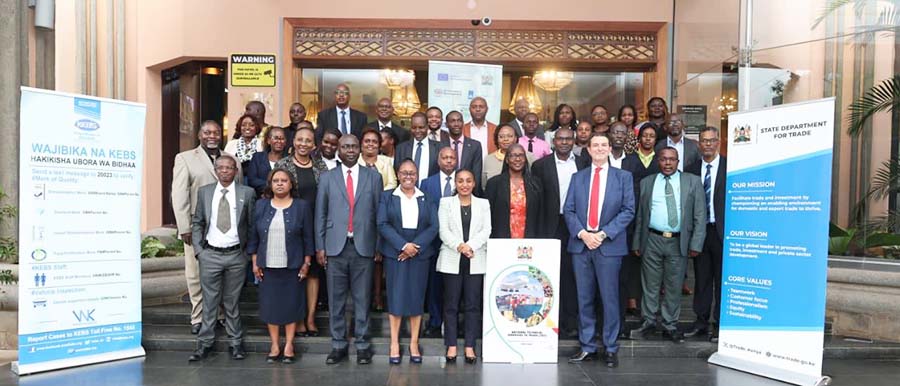
Trade PS Regina Ombam, who presided over the launch, described the initiative as timely and transformative.
“We have an opportunity to redefine how trade operates in the 21st century, positioning Kenya as a regional hub and ensuring that trade benefits our people and economy,” Ombam said.
Tackling the Hidden Costs of Trade
Trade experts highlight that non-tariff barriers, especially technical ones such as standards and certification requirements, remain some of the biggest hurdles for exporters.
According to Lillian Mwai, Country Director at TradeMark Africa, technical barriers influence more than 80 percent of global trade in goods, and fragmented technical regulations or slow conformity assessment processes can add as much as 10 percent to export costs.
“Through the BEEEP programme, with EU support, Kenya is now better positioned to participate in regional and global trade platforms and ensure that issues affecting Kenyan exports are addressed more effectively,” Lillian Mwai explained.
Strengthening Kenya–EU Trade Ties
The European Union has reaffirmed its support for Kenya’s trade development efforts. Filipo Amato, EU Trade Counsellor at the EU Delegation to Kenya, noted that the EU remains one of Kenya’s key trade partners, accounting for about 21 percent of exports and 17 percent of imports.
“We view this committee not as a bureaucratic layer, but as a bridge between Kenya and its trading partners,” Amato said, underscoring the EU’s continued commitment to supporting Kenya’s reforms in trade facilitation and standards alignment.
Route to Global Competitiveness
The National TBT Committee is expected to play a central role in promoting transparency, non-discrimination, and efficiency in Kenya’s trade regulations. Through harmonizing standards and ensuring that technical measures are fair and science-based, the Committee will help reduce trade delays, cut compliance costs, and enhance the credibility of Kenyan products in international markets.
Beyond trade facilitation, the initiative is also seen as a driver of sustainable growth. With coordinated efforts across institutions, Kenya aims to unlock new export opportunities while ensuring consumer safety and environmental protection.
While Kenya moves to implement the five-year TBT Strategic Plan, the focus will be on building strong institutional linkages, involving the private sector in decision-making, and improving information flow between regulators and exporters.
By 2029, the country hopes to have established a transparent, responsive, and globally respected trade standards system that positions Kenya as a regional leader in setting and upholding world-class standards.