
Scientific facts in cold chain management 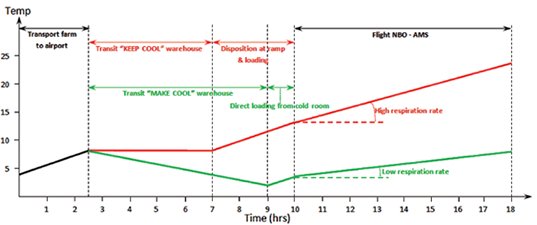 Although a scientific approach of post harvest technology for fruits, vegetables and flowers goes back to the 1970’s, many partners in the logistic chain still lack awareness and knowledge of basic principles. All efforts that the producer has made to reach top quality products may be lost within 24 hours by mismanagement of the cold chain. The small gain made by saving on the cold chain is negligible compared to the loss of value it will cause. Proper cold chain management from farm till buyer is an essential condition for the preservation of the quality and the value of a perishable product.
The respiratory metabolism
Cut flowers, harvested fruits and vegetables are still alive and carry on characteristic processes of all living things. The most important process is the respiratory metabolism. It is a natural process of ripening, senescence and deterioration of the plant. The bio-chemical reaction (for 1 mole): C6H12O6 + 6O2 + 6CO2 + 6H2O + 686 kcal 294 kcal of the produced energy is used for internal processes but 392 kcal is heat. Cut flowers, beans and the vast majority of Kenyan fresh produce are climacteric plants and have a very high respiration rate. The respiration is triggered by ethylene, a self-regulatory hormone produced by the plant itself.
 Export Processing Zone (EPZ) program was established in 1990 to provide an attractive investment opportunity for export-oriented business ventures within designated areas or zones. This sought to help the economy through increased productive capital investment, jobs generated, technology transferred, backward linkages developed and diversified exports.
 We expect to be one of a new line of white varieties that will be introduced into the market place. From the trials we have conducted it will be most suited for high altitude, the bud size will be between 6 to 7cm tall, stem length will be 50-80 cm. Transport and vase life are good. Production figures are yet to be concluded, estimates are of 90 to 120 stems m2 at high altitude.
 Horticulture is a significant ‘manufacturing’ industry. But where would horticulture be without knowledge exchange? This rhetorical question is the starting point for the Naivasha Horticultural Fair, which was initiated fifteen years ago. The knowledge from these exchanges has been of help to many businesses.