
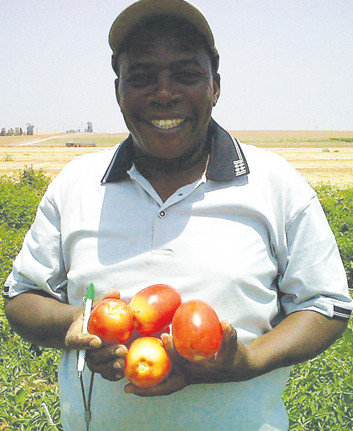
 Briefly discuss Wilfred Muthamia (background and chief agronomist Amiran Kenya Ltd) I was brought up in a farming community and had keen interest in Agriculture since my early childhood. For instance I headed the 4K club (Kungana, kufanya, kusaidia Kenya) where we practiced vegetable growing and rabbit keeping.
In secondary school I was the treasurer of the Young farmers club. We grew and sold cabbages to our School. Later on, I joined The University of Nairobi where I studied and graduated with BSc in Agriculture and MSc in Horticulture.
Due to my strong passion for teaching Agriculture, I proceeded to Egerton University and graduated with Post Graduate Diploma in Education (PGDE) in 1996. I briefly taught at Kenya Polytechnic (Currently Kenya Polytechnic University College) and Jomo Kenyatta University of Agriculture and Technology. After this I developed interest in Agrochemicals and quit formal teaching for venture into sales and product development at Farmchem Ltd.
In 2003 I joined Twiga Uganda ltd as the Agriculture Manager, where I worked for 4 years and later on came back to Kenya and joined Amiran (K) Ltd as the chief Agronomist, the post I hold to date.
How would you describe your time as the Chief Agronomist/Business Development Manager at Amiran? Are you passionate about what you do?
It is very interesting! Am very passionate working with farmers. My greatest satisfaction is satisfying our customer needs. Almost every day there are myriad of technical issues which land on my desk. Amiran is a one stop shop for all technical queries, even regarding other companies product land here and we have to assist all our customers regardless of which product they want.
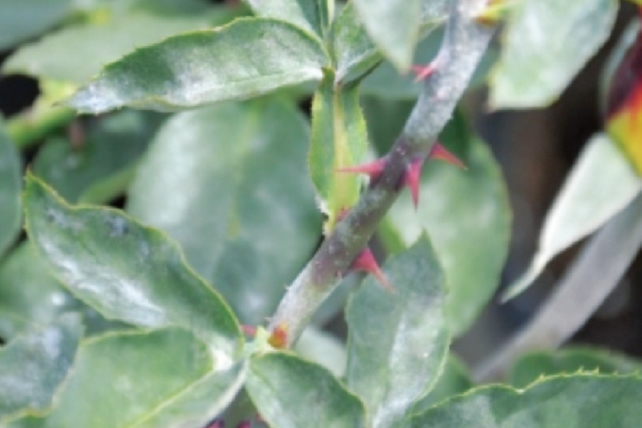 Powdery Mildew BluesThe farmers’ constant nuisance Powdery mildew has since time immemorial wrecked havoc to the farmers and still with the modern science continues to be an headache among farming communities, dare ask a Rose grower, cucumber, mango, strawberry to name but a few, which disease consumes their time, labor and resources more, surely he/she will not forget powdery mildew.
 All of the management positions in flower business contribute to the overall success of the operation. Perhaps none has a more direct hand in the ultimate quality of the company’s product, however, than the head grower. It’s a position that has evolved over time from skilled plantsman to grower, trainer, communicator, business manager and leader.
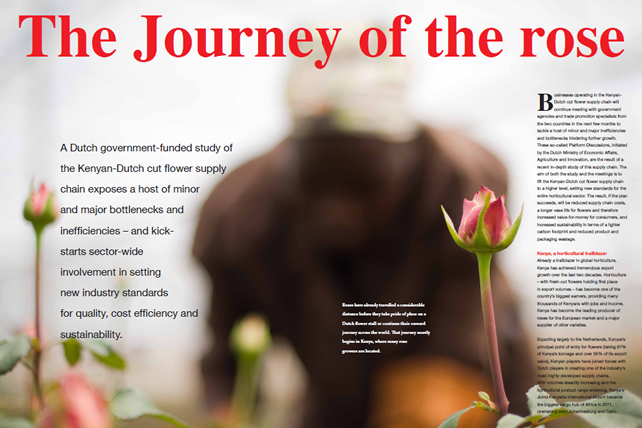 Businesses operating in the Kenyan-Dutch cut flower supply chain will continue meeting with government agencies and trade promotion specialists from the two countries in the next few months to tackle a host of minor and major inefficiencies and bottlenecks hindering further growth. These so-called Platform Discussions, initiated by the Dutch Ministry of Economic Affairs, Agriculture and Innovation, are the result of a recent in-depth study of this supply chain. The aim of both the study and the meetings is to lift the Kenyan-Dutch cut flower supply chain to a higher level, setting new standards for the entire horticultural sector. The result, if the plan succeeds, will be reduced supply chain costs, a longer vase life for flowers and therefore increased value-for-money for consumers, and increased sustainability in terms of a lighter carbon footprint and reduced product and packaging wastage.
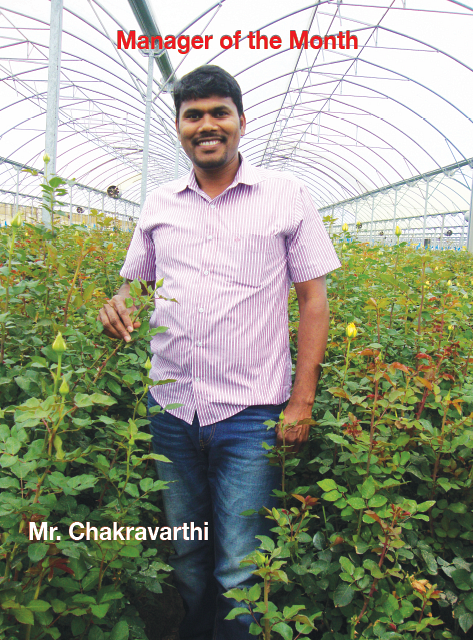 Chakravarthi : The Grower.
 Naivasha flower farms that subscribe to Fairtrade (FLO) standards and are Fairtrade certified have completely changed the image of the District hospital maternity wing. Initially it was an image of 20 women in labour crowded in one central room quietly moaning and swaying until it is their time to go to one large delivery room to deliver in a cot-directly next to another mother giving birth. To date, it is one of the nicest African facilities handling over 500 deliveries monthly. Women and new borns can now enjoy privacy, respect and safety they deserve during their birth experiences.
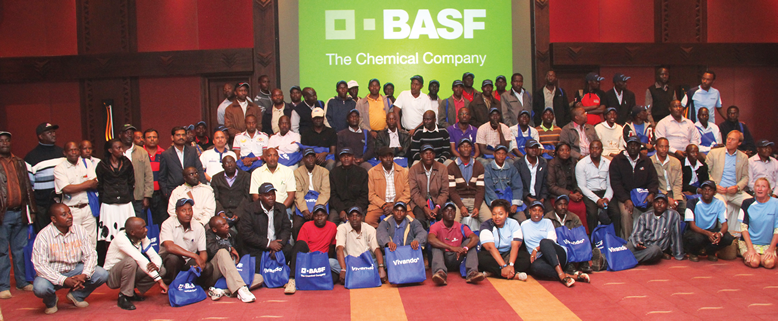 Viva… Viva… Vivando, Viva… Viva… Vivando, filled the air as one of the biggest chemical companies in the world, BASF, launched a creative mode of action with cutting edge technology for the control of powdery mildew in ornamentals. Time almost audio recorded voice of Mr. Patrick Ngugi, Country Manager-Kenya, Crop Protection and public health asked, “Are you afraid of powdery mildew? Are you concerned by the ever increasing threat of resistance build up by fungicides? Are you concerned of scotching flowers and leaving residue? Are you concerned of WHO class of your choice product, Can you achieve your goals in farming without IPM? Do you use wetter from time to time?” Each of the questionreceived a resourcing ‘Yes’ from the over 150 growers in attendance. Today I stand in front you to offer your solution, Vivando.
 The floricultural arm of the illustrious Sunland Roses, sits like a jewel in the crown of the multi-faceted conglomerate. One of the leading farms for rose cultivation, Sunland Roses is a success story built upon years of dedication, and focused expansion.
 Damien Viollet, a Frenchman working for a German company doing business in East Africa, is at the coalface of juggling multiple, fundamentally different cultures. While Damien grew up in France, he has also lived in Germany in his adulthood and had to quickly learn that, for better or for worse, many stereotypes of the two nations contain an element of truth. And knowing how to handle them can open many doors. “The business environments in Germany and African countries are also completely different”, explains Mr. Damien.
 The crop protection industry is dominated by the large multinational agro-chemical companies such as Syngenta, Monsanto and Bayer Cropscience. The biocontrol business is minute in comparison, with only 3% of global sales of crop protection products. The future of the biocontrol industry is based on a range of interacting factors and difficult to predict the future, however many are suggesting that its future is likely to grow. There are numerous drivers for the use of biological control.