
January 22, 2026
Caterpillars have emerged as a significant seasonal threat to floriculture and horticultural crops, causing disproportionate economic losses when populations peak. Although often present for limited periods, their impact can be severe: a single caterpillar can damage multiple flowers, rendering them unmarketable.
In flower production systems, there are several caterpillar species, notably Helicoverpa armigera and Spodoptera exigua. Accurate pest identification is therefore critical, particularly because Helicoverpa armigera is regarded as the more destructive species and is classified as a quarantine and notifiable pest in key export markets, including the European Union.
Caterpillars damage leaves, buds, growing points and flowers. Leaf feeding reduces photosynthesis and plant vigour, but flower injury causes the greatest economic loss. Larvae bore clean holes, contaminate blooms, and enable secondary rots. Rapid spread is common. Helicoverpa armigera is especially critical due to its quarantine implications for exports and markets.
Integrated Pest Management Approach
Effective caterpillar control relies on a robust Integrated Pest Management (IPM) programme. This includes regular monitoring of pest populations, the use of cultural practices to reduce pest pressure, biological control where feasible, and the judicious use of insecticides. Scouting should focus on early detection of eggs and young larvae, as control is most effective at these stages.
Importance of the Life Cycle
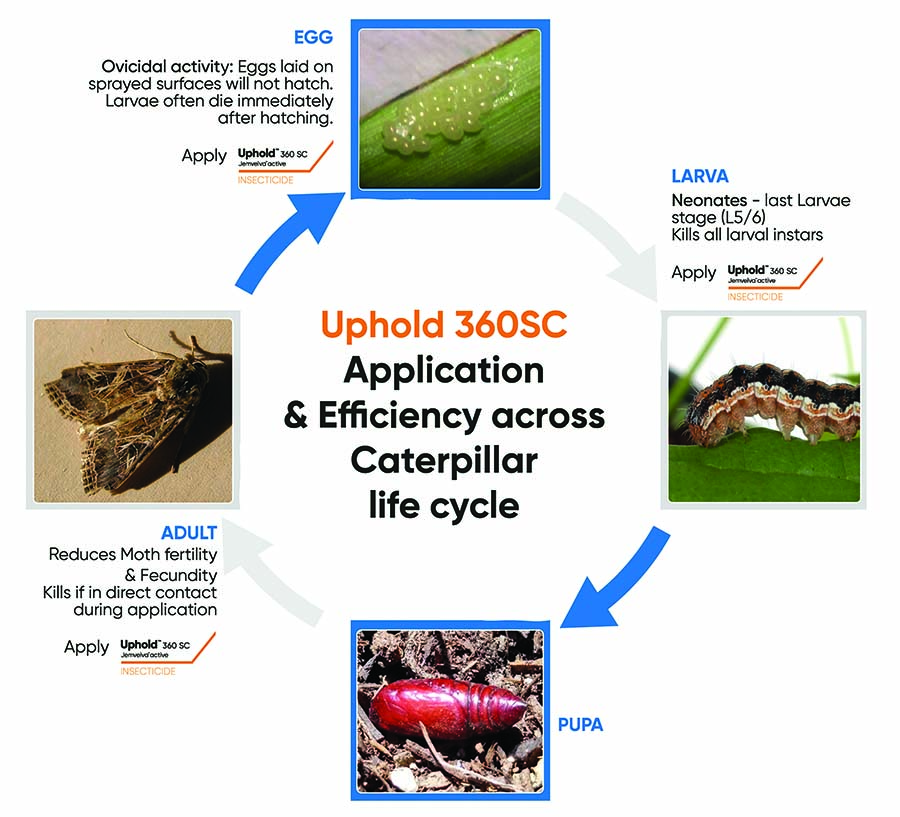
Understanding the caterpillar life cycle is fundamental to achieving optimal control. Caterpillars represent the larval stage of moths or butterflies, and it is during this stage that economic damage occurs. Knowledge of pest development allows agronomists and growers to time interventions accurately, maximizing efficacy while minimizing input costs and environmental impact.
Resistance Management Considerations
Resistance management is a critical component of caterpillar control programmes. Younger larvae are significantly more susceptible to plant protection products than older instars, underscoring the importance of early intervention. Monitoring adult moth activity can help predict larval emergence and guide spray timing. In addition, good spray coverage is essential, as caterpillars often feed within protected plant structures.
To prevent resistance development, it is essential to rotate insecticides with different modes of action. Product rotation should be based on recognized IRAC (Insecticide Resistance Action Committee) groups rather than product names alone. Avoiding consecutive applications of products with the same mode of action reduces selection pressure. Where repeated applications are unavoidable, switching promptly to a different IRAC group becomes even more critical.
Role of Uphold® 360 SC
Growers facing increasing caterpillar pressure can consider Uphold® 360 SC from Corteva Agriscience as an effective solution within IPM and resistance-management programs. The product contains spinetoram (60 g a.i./L) and methoxyfenozide (300 g a.i./L), offering both contact and stomach ingestion activity for reliable control of caterpillars at different growth stages. Uphold® 360 SC is effective against key lepidopteran pests across multiple life stages.
Availability and Support in Kenya
In Kenya, Uphold® 360 SC is marketed by Corteva Agriscience and distributed by Elgon Kenya Ltd., providing growers with reliable access, technical support and stewardship guidance.
In conclusion, caterpillars remain a persistent and economically significant threat to floriculture and horticultural systems. However, by understanding pest biology, monitoring populations early and implementing disciplined resistance management within an IPM framework, growers can substantially reduce losses. An integrated strategy that combines cultural, biological and chemical tools is essential for protecting crop quality, maintaining export compliance and ensuring sustainable, profitable production.