
November 20, 2025
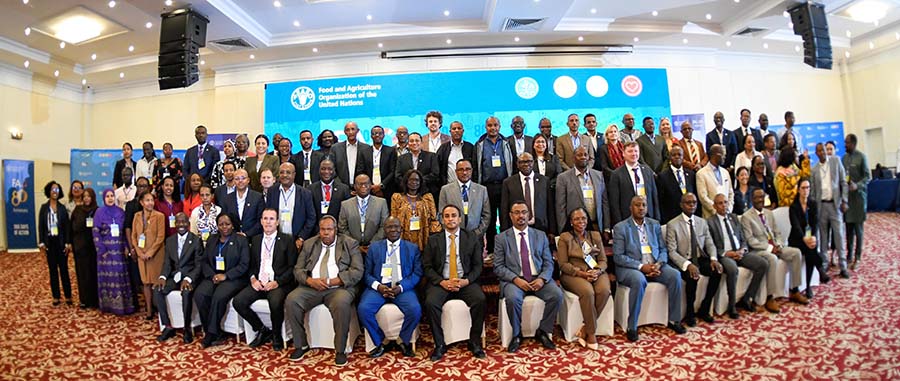
East African countries have outlined a renewed push to strengthen food security, climate resilience and regional cooperation following a high-level meeting held in Addis Ababa, Ethiopia. The 19th Multidisciplinary Team Meeting, convened by the Food and Agriculture Organization (FAO) and Ethiopia’s Ministry of Agriculture, brought together government leaders and technical experts to evaluate progress and identify investment priorities for the region’s agrifood systems.
Opening the meeting, Ethiopia’s State Minister for Agriculture, Meles Mekonnen, emphasised the importance of aligning national efforts with regional objectives. He highlighted ongoing initiatives in irrigation expansion, commercial agriculture, and soil and landscape restoration, noting that coordinated approaches can deliver stronger and more sustainable results across Eastern Africa.
The gathering came at a time when the region faces intensifying food insecurity. According to FAO Ethiopia Representative Farayi Zimudzi, nearly 75% of Eastern Africans cannot afford a healthy diet, and one in three children under five is stunted. He warned that climate pressures, resource constraints and uneven investment continue to undermine agrifood systems, urging countries to accelerate long-term resilience measures.
FAO Assistant Director-General and Regional Representative for Africa, Abebe Haile-Gabriel, called for stronger partnerships backed by sustained financing to move innovations beyond pilot scale. He stressed that meaningful transformation requires government commitment, regional collaboration and investment flows that match the scale of the challenges.
Discussions throughout the meeting focused on interventions that can help countries shift from fragmented agricultural projects to integrated, climate-smart and market-oriented systems. Delegates examined opportunities to scale irrigation, restore degraded landscapes, strengthen soil health and enhance the uptake of digital agriculture tools.
A major theme was the need to deepen regional coordination. Harmonizing sanitary and phytosanitary standards, improving cross-border trade frameworks, and leveraging the African Continental Free Trade Area were identified as key steps toward building more competitive and connected agricultural markets.
Participants also underscored the importance of embedding agrifood system reforms into national budgets, rather than relying heavily on external funding. This, they agreed, is essential for ensuring continuity, scaling successful initiatives and attracting private investment.