
October 16, 2025
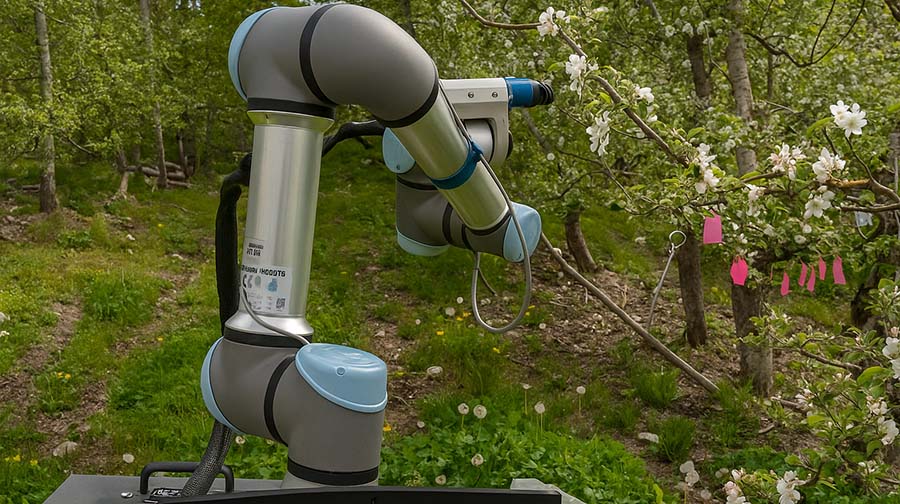
As agricultural practices evolve towards more controlled environments such as greenhouses and indoor farms, the challenge of effective pollination becomes increasingly critical. Traditional pollination methods relying on natural wind or commercial pollinators like bumblebees often face limitations due to regulatory constraints and environmental control. A new robotic system promises to overcome these challenges by combining advanced vision technology with precise mechanical action to perform automated pollination safely and efficiently.
A significant step forward has been reported by researchers Jaehwan Jeong, Tuan-Anh Vu, Radha Lahoti, Jiawen Wang, Vivek Alumootil, Sangpil Kim, and M. Khalid Jawed in a recent study published on arXiv.
What the Research Entails
The team of researchers has developed a vision-guided robotic framework that integrates three key innovations: 3D reconstruction of plants, targeted grasp planning, and vibration-based pollen release. This system uses an RGB-D sensor mounted on a robotic arm’s end-effector to capture detailed three-dimensional images of plants. By reconstructing the plant structure and mapping it onto the robot’s coordinate system, the robot identifies the best unobstructed points on the main stem for grasping.
Precision Grasping and Controlled Vibration
The robot is equipped with soft grippers designed to grasp the plant stems gently without causing damage. Using a discrete elastic rod physics model, the system predicts how different vibration parameters affect the flower’s movement, enabling the robot to select optimal vibration settings. These vibrations encourage efficient pollen release while ensuring the delicate flower structures remain intact.
Promising Results
Experimental trials of this integrated system show a 92.5% success rate in grasping the main stem, a critical step for effective pollination. Simulation-guided optimization of vibration parameters further confirms that the robot can perform pollination tasks with high precision and safety, minimizing damage to flowers and maximizing pollination efficiency.
Significance and Future Impact
This research represents the first robotic system to combine vision-based grasping and vibration modeling for automated pollination, marking a significant step forward in agricultural robotics. By providing a reliable alternative to manual pollination and natural pollinators, this technology has the potential to enhance crop yields in controlled environments, contribute to food security, and support sustainable farming practices.
For more information, visit arXiv.?