
30: 04: 2026
Love, much like a flower bouquet, rarely comes in a single shade. It is an unpredictable arrangement of reds, whites, yellows, roses and summer blooms all bundled together, with the occasional thorny stem waiting to prick when least expected. A good bouquet is never made of identical roses lined up like soldiers on parade. It is a riot of varieties, colours and fragrances somehow agreeing to coexist in one vase. Human relationships are not very different, though some people, especially a certain Dutch professor with a Cuban cigar, would strongly disagree.
“These are not flowers grown in Kenya, auctioned in Holland and purchased by Americans or Germans,” Dr Marco van Nisiteroy declared one afternoon with the grim finality of a man announcing a fungal outbreak in the propagation unit. “They are people. People do not simply blend because it looks good on paper. They compromise. And compromise,” he added darkly, “is not always the best fertilizer for a happy marriage.”
Dr van Nisiteroy was not the sort of man one casually argued with unless one had first updated one’s will. A professor of plant pathology seconded from The Netherlands to one of Kenya’s leading flower farms, he also lectured part-time to postgraduate students, terrifying them into academic excellence.
He looked less like a scientist and more like an old Dutch sea captain who had somehow abandoned piracy for petri dishes. Tall and broad, with a polished bald head that reflected sunlight like a greenhouse roof, a magnificent grey beard and eyes sharp enough to detect powdery mildew at fifty paces, he completed the picture with a Cuban cigar permanently hanging from his lips like a punctuation mark of authority.
His résumé was equally alarming. Educated at one of Amsterdam’s finest universities, he had spent decades researching flowers, worked with Dutch floriculture giants, survived a stint in South Africa and was eventually dispatched to Kenya, presumably because the flowers here needed intimidating.
We became friends after meeting at an industry event. He occasionally contributed articles to this magazine under various pseudonyms, perhaps to protect his reputation from my editing.
One day he called.
“My daughter is arriving from Holland for the holidays,” he announced. “I am hosting a party. Young people, mostly my students. Come and keep me company. Also, check the standard of their English.”
Nothing elevates a journalist faster than being invited as quality control.
The party turned out to be a lively cultural bouquet of Kenyan, Dutch, Asian and African students mingling with the effortless ease that makes one suspect young people are far less interested in cultural divisions than their elders would like to believe. Professor van Nisiteroy’s daughter, Jacqueline, moved among them gracefully while her father observed with the protective vigilance of a man guarding a newly patented rose variety.
As the evening wore on, he suddenly shoved me toward the microphone.
“This professor from the media,” he announced grandly, “will now say a few closing words.”
The audience erupted in whistles and applause. It was less an invitation than an ambush.
“Ladies and gentlemen,” I began, adjusting to this emergency assignment, “journalism prepares one for many crises: political scandals, delayed flower shipments and editors with impossible deadlines. But this is my first experience of being forced to deliver a speech with no warning and no visible escape route.”
That earned a laugh, so I pressed on with an old anecdote about three women being interviewed for a demanding flower farm management position.
The British candidate was asked what she would do if stranded on a desert island with one hundred men.
“I would divide them into football and cricket teams to keep them occupied,” she replied.
The American candidate answered next.
“I would establish a military-style camp and assign everyone duties.”
Finally, the Frenchwoman was asked the same question. She sat quietly for a moment. The panel repeated it.
She smiled politely and said, “I understand perfectly, monsieur… but what exactly is the problem?”
The room exploded with laughter.
“And that,” I concluded, “is precisely the kind of composure one needs in floriculture: the ability to look at delayed flights, customs hiccups, wilting tempers and complete logistical chaos and calmly ask, ‘What exactly is the problem?’”
When the laughter subsided, I noticed Jacqueline deep in conversation with a young Kenyan journalist I had introduced to her earlier that evening, Macharia. Their chemistry was budding faster than roses under perfectly calibrated drip irrigation.
Guests exchanged contacts, bouquets were handed out courtesy of the farm, and the evening ended with the kind of optimism only youth and free flowers can generate.
Over subsequent visits, Jacqueline and Macharia’s friendship blossomed into something rather more permanent.
Then came the announcement.
“Father,” she said, “Macharia and I intend to marry.”
If thunder could emerge from a greenhouse office, that was the moment.
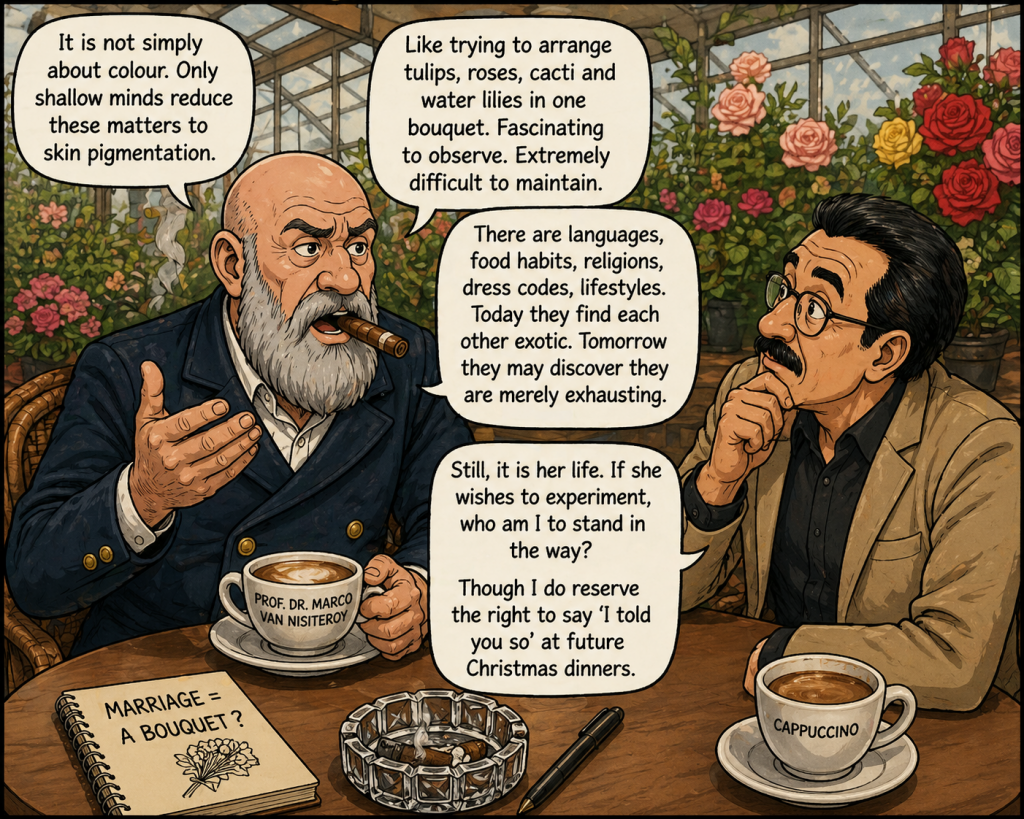
Later that day, the professor summoned me for cappuccino. Seated opposite me, tapping cigar ash into a crystal tray with judicial precision, he launched into his objections.
“It is not simply about colour,” he said, stroking his beard as though consulting it for legal advice. “Only shallow minds reduce these matters to skin pigmentation.”
I nodded solemnly and played devil’s advocate.
“But surely,” I suggested, “what a rich cultural experience it would be.”
“Yes,” he replied grimly. “Like trying to arrange tulips, roses, cacti and water lilies in one bouquet. Fascinating to observe. Extremely difficult to maintain.”
He leaned forward.
“There are languages, food habits, religions, dress codes, lifestyles. Today they find each other exotic. Tomorrow they may discover they are merely exhausting.”
Then, with the resignation of a man who knew resistance was futile, he sighed.
“Still, it is her life. If she wishes to experiment, who am I to stand in the way?”
He paused thoughtfully.
“Though I do reserve the right to say ‘I told you so’ at future Christmas dinners.”
And there, like an unfinished bouquet waiting for its final stem, the matter rested for the moment.
What happened next is, as they say in both love and floriculture, another season’s story.