
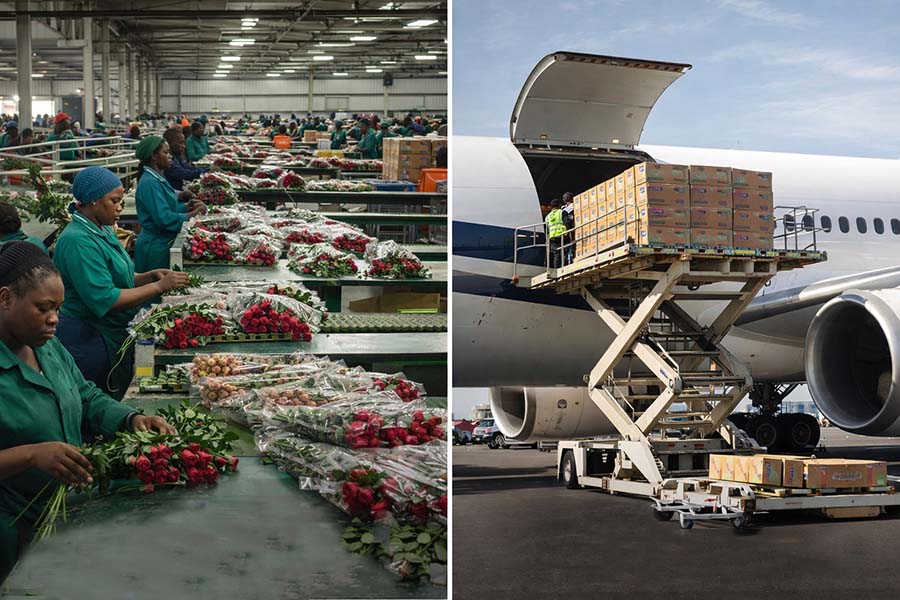
Kenya’s flower exporters are watching developments in the Middle East with growing concern as rising geopolitical tensions threaten to disrupt one of the most critical logistics corridors for the country’s horticulture trade. Kenya exports significant volumes of flowers and fresh produce to markets such as the United Arab Emirates,
Qatar and Saudi Arabia. Beyond these destination markets, Gulf aviation hubs serve as vital transit points for Kenyan perishables bound for Europe and Asia.
Any disruption within this network quickly reverberates across the entire supply chain.
Recent tensions involving Iran, Israel and the United States have already created uncertainty in global aviation. For exporters, the greatest risk lies in potential airspace closures and flight rerouting that can reduce cargo capacity, delay shipments and push freight costs higher.
The impact has already been felt along the key Nairobi–Dubai corridor linking Jomo Kenyatta International Airport with Dubai. For nearly a week, the route remained largely inactive, temporarily interrupting one of the most important export channels for Kenya’s floriculture industry.
Major Gulf carriers including Emirates, Etihad Airways and flydubai have since begun restoring limited passenger and cargo operations as they navigate restricted airspace corridors.
According to the Kenya Flower Council, the Middle East accounts for roughly 10–15 percent of Kenya’s flower exports. When flights are suspended or rerouted, cargo quickly accumulates at origin airports while exporters scramble for alternative capacity. Industry estimates suggest that the disruptions may have resulted in daily losses of between KES 150 million and KES 200 million.
The temporary suspension of certain routes by Kenya Airways, including flights to Dubai and Sharjah, further complicated the situation, forcing exporters and freight forwarders to divert shipments to alternative markets—often at lower prices and with higher logistics costs.
The effects have also been felt in Europe. Traders linked to the flower auction system in Aalsmeer, home to the global marketplace operated by Royal FloraHolland, reported temporary supply gaps as Kenyan cargo aircraft remained grounded.
Data from the Kenya National Bureau of Statistics shows that floriculture remains one of Kenya’s leading sources of foreign exchange, alongside tourism, tea, coffee and diaspora remittances.
As flights gradually resume, industry stakeholders are focusing on restoring cargo flows while exploring alternative routes that could reduce dependence on a single transit corridor.
For Kenya’s highly time-sensitive floriculture sector, the episode serves as a stark reminder of how geopolitical tensions far beyond its borders can quickly affect the delicate journey of a flower from farm to global market. In an industry where freshness defines value, every hour counts.