
February 19, 2026
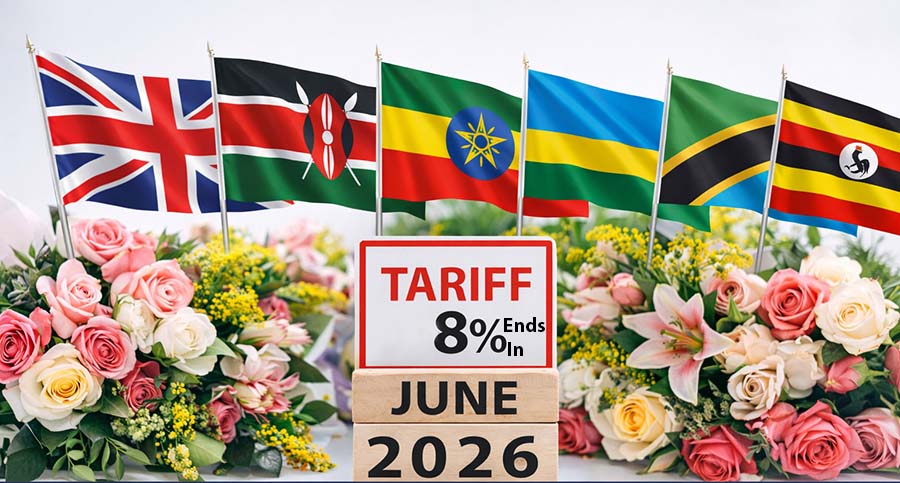
With fewer than four months remaining before 30 June 2026, the United Kingdom’s two-year suspension of its 8% Global Tariff on cut flowers is approaching expiry, injecting fresh uncertainty into one of Kenya’s most strategic export markets.
Kenya is the world’s fourth-largest flower exporter, supplying an estimated 40% of Europe’s roses, with the UK accounting for 18–20% of total exports. A reversion to duties would immediately raise landed prices, placing pressure on margins in a sector that supports over 200,000 direct jobs, earns vital foreign exchange, and anchors rural livelihoods.
Why It Matters
Introduced on 11 April 2024, the UK’s temporary 0% import duty on cut flowers granted unlimited, tariff-free access for East African producers, including shipments routed through the Netherlands. The measure significantly boosted competitiveness for growers in Kenya, Ethiopia, Rwanda, Tanzania, and Uganda, many of whom rely on Dutch auctions as a route to the UK market.
Absent of the extension, the UK’s post-Brexit UK Global Tariff (UKGT) will automatically reapply the Most Favoured Nation (MFN) rates:
- 8% ad valorem on fresh cut flowers (HS 0603)
- Up to 10% on certain preserved products
These rates apply universally unless superseded by new agreements.
Kenya’s Partial Shield and Its Limits
Kenya retains a degree of protection under the UK–Kenya Economic Partnership Agreement (EPA) signed in 2021, which mirrors EU terms. Direct exports benefit from duty-free quotas or reduced rates, historically saving the industry an estimated £10 million annually prior to the suspension.
However, transit shipments via the Netherlands, which account for a substantial share of UK-bound volumes, remain fully exposed to the 8% tariff once the suspension lapses. This exposure threatens the economics of auction-routed trade that underpins market access for many growers.
As of February 2026, there are no indications of an extension. Statements from the UK Department for Business and Trade reaffirm the fixed end date, leaving diplomacy and negotiation as the only viable paths forward.
Why the Suspension Mattered (2024–2025)
The waiver proved a crucial buffer during a period of acute pressure for Kenyan floriculture:
- Margin Stabilisation
The 8% relief helped offset a “perfect storm” of rising fertiliser and input costs, logistics disruptions and re-routing expenses, volatile market dynamics, and intensified competition, particularly from Ecuador.
- Trade Performance
The period saw short-term volume and value growth in the UK market, supporting record trade levels and safeguarding employment during a volatile cycle.
An Industry at a Crossroads
Kenya’s floriculture sector, valued at approximately US$1.1 billion, now faces a decisive moment. Kenya Flower Council CEO Clement Tulezi has described the suspension as delivering “significant relief” by enhancing competitiveness in the UK. He cautions, however, that with expiry looming, the coming months will be critical to securing longer-term certainty that protects jobs and sustains investment.
Echoing the collaborative tone, John Humphrey, UK Trade Commissioner for Africa, has emphasised the partnership’s mutual benefit, remarks reinforced at the Kenya-UK Business Forum in January 2026. Discussions there highlighted sustainable growth and investment milestones, including the expansion of Flamingo Flowers in Naivasha.
The Real-World Consequences
From July 2026, the impact will not be debated in policy rooms; it will be felt in payrolls, planting decisions, and purchase orders. In a market where buyers plan and hedge against uncertainty, delayed clarity carries real risk. Supermarket programmes, once shifted, rarely revert quickly. In an industry as competitive and time-sensitive as floriculture, trade flows can be redrawn quietly and decisively long before any formal announcement.
The window for action is narrowing. What happens next will shape Kenya’s position in the UK flower market for years to come.
| FAQ |
|---|
| Why Is the Netherlands So Central to This Issue? A substantial share of Kenyan flowers destined for the UK are routed through Dutch auctions and logistics hubs. The suspension covered flowers even when they transited through the Netherlands. If the waiver lapses, those transit volumes will once again attract the full 8% duty when entering the UK, significantly increasing landed costs. Does Kenya Have Protection Under a Trade Agreement? Yes, but only partially. The 2021 UK-Kenya Economic Partnership Agreement mirrors previous EU terms and allows duty-free access within defined quotas for direct exports from Kenya to the UK. However, it does not fully shield flowers that transit through the Netherlands, which make up a large portion of auction-based trade. Those volumes remain exposed if the suspension ends. Did the UK Market Grow During the Suspension? Yes. In the first half of 2025, Kenyan cut flower export volumes rose by 27%, reaching 66,688 tonnes compared to the previous year. The value of Kenyan cut flower imports into the UK increased by 21.6% in the first seven months of 2025. Broader bilateral trade between Kenya and the UK reached record levels by late 2025, rising from Sh340 billion in November to Sh360 billion by the final quarter of the year. Is There Any Sign of an Extension? As of February 2026, there are no public signals of an extension. Statements from the UK Department for Business and Trade maintain that the suspension will end on June 30, 2026, unless new measures are announced. |